Amazon PPC intelligence. More control at every step.
Terra PPC brings authorized advertising workflows, selected seller-business context, customer-configured economics, and controlled automation into one scoped operating workspace.
Designed for authorized advertising and seller-account workflows, subject to applicable access, permissions, and enabled functionality.
Designed for authorized account connections. No Amazon password sharing.
Synthetic dataRecorded from the running Terra PPC website and interactive demo with synthetic data — not live Amazon data.Read transcriptChapters
Five product pillars
Advertising Intelligence
Search term to campaign strategy, in one scope.ExploreSeller Business Intelligence
Sales, finance, inventory and listings, where authorized.ExploreEconomics & Profitability
Customer-configured costs, price history and modeled P&L.ExploreControlled Automation & Safety
Rules and strategies behind guardrails and modes.ExploreAI, Trust & Control
Governed AI/MCP, separate authorization, provenance and audit.Explore
Advertising intelligence from search term to campaign strategy.
Organize authorized advertising performance by campaign, ad group, keyword, target, search term, placement, hour, profile, marketplace and time period — and turn each pattern into a reviewable next step.
Campaigns
SP | Black Gift Boxes — Exact
Auto$593.40 spend · $3,260.40 ad-attributed sales
ACoS 18.2% · target 25.0% · ROAS 5.49
SP | Discovery — Auto
Review$421.18 spend · $1,007.60 ad-attributed sales
ACoS 41.8% · target 30.0% · ROAS 2.39above target
SP | Brand Defense — Exact
Auto$321.76 spend · $3,422.98 ad-attributed sales
ACoS 9.4% · target 15.0% · ROAS 10.64
SP | Competitor Product Targeting
Manual$214.33 spend · $411.38 ad-attributed sales
ACoS 52.1% · target 30.0% · ROAS 1.92above target
SP | Corrugated Mailers — Broad
Review$198.76 spend · $633.00 ad-attributed sales
ACoS 31.4% · target 24.0% · ROAS 3.18above target
SP | Long Tail Discovery — Phrase
Auto$156.21 spend · $788.94 ad-attributed sales
ACoS 19.8% · target 22.0% · ROAS 5.05
SP | Seasonal Gifts — Auto
Review$143.90 spend · $523.27 ad-attributed sales
ACoS 27.5% · target 26.0% · ROAS 3.64above target
| Campaign | Ad Spend | Ad-attributed Sales | ACoS | ROAS | Target ACoS |
|---|---|---|---|---|---|
| SP | Black Gift Boxes — ExactAuto mode | $593.40 | $3,260.40 | 18.2% | 5.49 | 25.0% |
| SP | Discovery — AutoReview mode | $421.18 | $1,007.60 | 41.8%above target | 2.39 | 30.0% |
| SP | Brand Defense — ExactAuto mode | $321.76 | $3,422.98 | 9.4% | 10.64 | 15.0% |
| SP | Competitor Product TargetingManual mode | $214.33 | $411.38 | 52.1%above target | 1.92 | 30.0% |
| SP | Corrugated Mailers — BroadReview mode | $198.76 | $633.00 | 31.4%above target | 3.18 | 24.0% |
| SP | Long Tail Discovery — PhraseAuto mode | $156.21 | $788.94 | 19.8% | 5.05 | 22.0% |
| SP | Seasonal Gifts — AutoReview mode | $143.90 | $523.27 | 27.5%above target | 3.64 | 26.0% |
| All campaigns | $2,049.54 | $10,047.57 | 20.4% | 4.90 | 22.1% weighted |
All campaigns: $2,049.54 spend · $10,047.57 ad-attributed sales · ACoS 20.4%
- Campaign ManagementSpend, ad-attributed sales, ACoS, ROAS, Target ACoS and modeled break-even for every campaign, with its automation mode.
- Search-Term IntelligenceWhich customer search terms convert, which only spend and which still need data — with harvest and negative workflows.
- N-Gram IntelligenceWord patterns across search terms — waste, winner and mixed patterns — with one negative per pattern and campaign.
- Placement OptimizationTop of search, rest of search and product pages compared by campaign, with placement adjustment proposals.
- Hourly OptimizationHour-of-day performance and budget consumption turned into schedule proposals.
- Budget Planning & PacingA monthly plan, daily pacing against it, and reallocations that never raise the total.
When a search term has spend but no attributed sales, ACoS is shown as —, not 0%, and ROAS as 0.00.
Advertising performance is only part of the picture.
Where authorized, Terra PPC is designed to use selected seller-business context to help teams understand sales, financial activity, inventory, listings, fulfillment, and retail performance alongside advertising workflows.
- Sales & TrafficReview seller revenue, orders, units, traffic and conversion context.
- Finance & SettlementsReview fee, refund, adjustment, reimbursement and settlement context where authorized.
- Inventory & FBAUnderstand fulfillable, inbound, reserved and constrained inventory before scaling advertising.
- Listings & Product ContextKeep SKU, listing, catalog and applicable fee context visible.
- Brand & Retail AnalyticsUse retail and search behavior where authorized and available.
- Seller & Marketplace InsightsSee marketplace participation and seller-performance context for each authorized account.
Seller business context
Economics that change when the business changes.
Terra PPC can use customer-configured product economics alongside seller and advertising context to model margins, break-even advertising thresholds, and profitability over time.
COGS, landed cost and other costs are configured by the customer — they do not come from Amazon. Profit is modeled: it is not an accounting statement.
Explore Economics & ProfitabilityFrom a supplier cost change to an automation decision
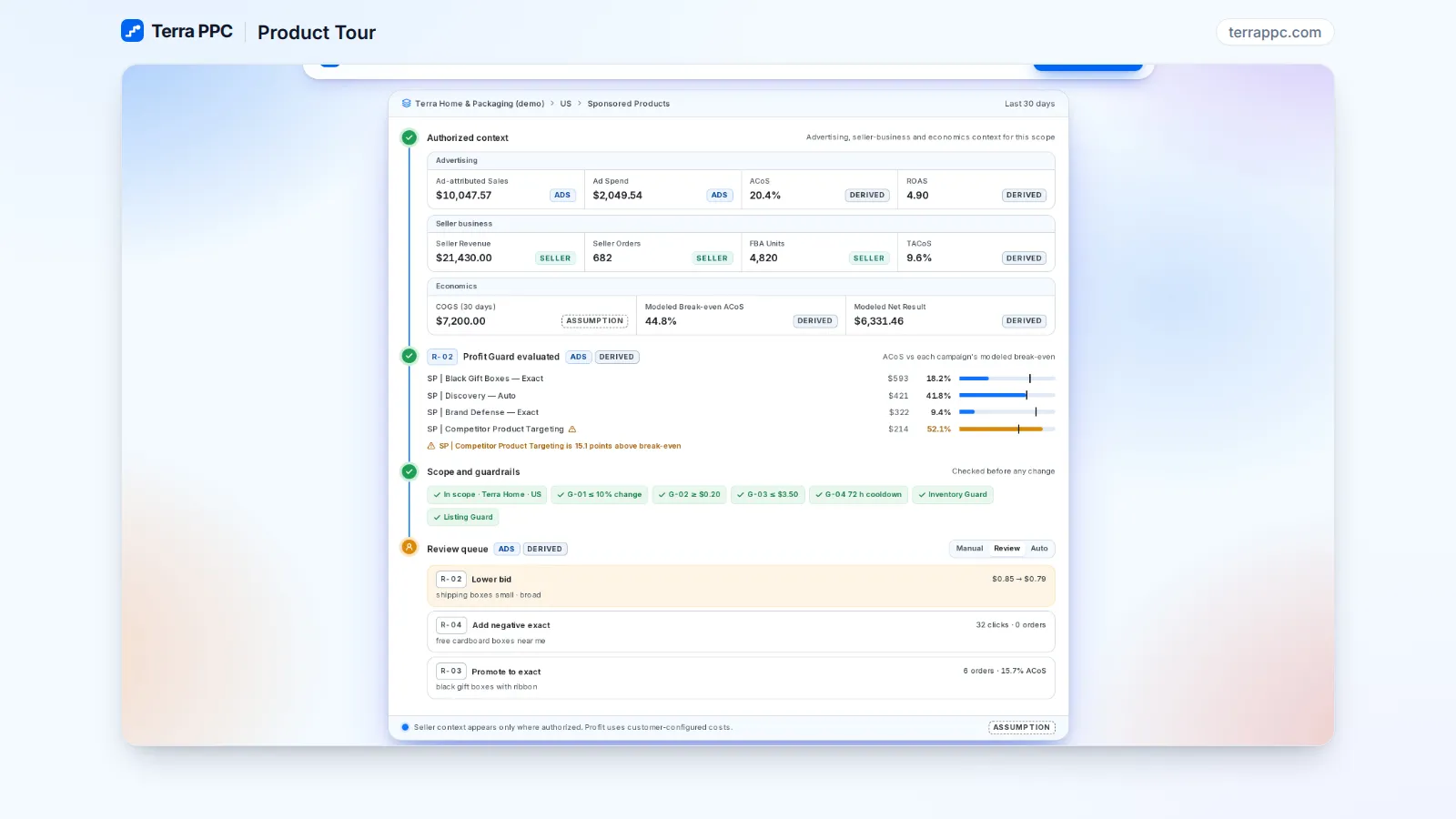
One decision can depend on more than ACoS.
A rising ACoS means something different when inventory is low, a listing is suppressed or a supplier raised the unit cost. Terra PPC is designed to read authorized advertising data, selected seller-business context and the customer's own economics together — one scope at a time.
Illustration of the Terra PPC decision context with synthetic values from the Terra Home & Packaging demo account, US marketplace, last 30 days. Advertising data: ad-attributed sales $10,047.57, ad spend $2,049.54, ACoS 20.4%, ROAS 4.90. Seller-business context: seller revenue $21,430.00, 682 seller orders, 4,820 FBA units, TACoS 9.6%. Economics: COGS $7,200.00 (customer-configured), modeled break-even ACoS 44.8%, modeled net result $6,331.46. Rule R-02 Profit Guard compares each campaign with its modeled break-even ACoS; SP | Competitor Product Targeting is 15.1 points above break-even. Scope, guardrails G-01 to G-04 and the inventory and listing guards pass. In Review mode, three recommendations wait for approval: a bid change from $0.85 to $0.79, a negative exact keyword, and a search-term promotion.
IllustrativeIllustrative product interface with synthetic values from the Terra PPC interactive demo — not live Amazon data.
Profit-aware decision context
Production availability of cross-source workflows depends on authorized integrations, approved functionality, applicable Amazon permissions, and enabled account scope.
Customer economics such as COGS, other costs and desired margin are configured by the customer. They do not come from Amazon.
Automation with visible logic.
Rules are intended to produce understandable decisions rather than unexplained black-box actions.
Trigger. A scheduled cycle or a user starts an evaluation for one scope.
Rule evaluation. Metric thresholds, minimum data and lookback windows you configure.
Strategy. The campaign's strategy decides which rules run and how cautiously.
Execution planner. A fixed order: data readiness, safety, proposals, conflicts and limits.
Guardrails. Floors, ceilings, change caps, cooldowns and business guards every action must pass.
Manual / Review / Auto. Your chosen mode decides whether an action is previewed, queued or applied.
Advertising actions can respect business constraints.
Where authorized seller context and customer economics are available, Terra PPC can evaluate business conditions before a proposed advertising action continues.
Guards hold scale actions — bid, budget and placement increases, re-enables and harvests. They never pause advertising on their own, and every held action is recorded.
Condition → result
Illustrative logicInventory Guard
Low days of cover → Hold scale
Listing Guard
Suppressed or inactive listing → Hold · route to review
Break-even & Margin Guards
ACoS above modeled break-even, or margin below the minimum → Hold scale
Circuit Breakers
Unsafe action volume or spend exposure in one cycle → Pause automatic execution
Choose how much control to delegate.
Manual keeps direct control. Review turns rule results into recommendations that need approval. Auto executes eligible actions only after policy and guardrail evaluation. Every mode stays subject to scope, permissions, guardrails and the audit log.
Manual: Automation can be inspected or simulated, but it does not apply operational changes. Users make changes themselves, and those changes are scoped, checked and recorded too.
Review: Rules evaluate conditions and Terra PPC creates recommendations. Nothing executes until a user approves it.
Auto: Eligible actions apply automatically inside the configured scope, permissions and guardrails, and each one is written to the audit log.
Automation mode does not bypass account authorization, scope, guardrails, permissions or audit logging.
Every mode follows the same trunk: scope and data readiness, rules under the campaign's strategy, the execution planner and guardrails, including business-aware guardrails where seller context is authorized. Manual ends in a preview with no automatic change; changes a user makes are recorded in the audit log. Review creates a recommendation that must be approved before it is applied and recorded in the audit log. Auto applies eligible actions within guardrails and records them in the audit log.
Manual
Direct control. Users review data and make operational choices themselves.
Review
Recommendation-first. Rules evaluate eligible data and create recommendations for human approval.
Auto
Guardrailed execution. Eligible rule actions may execute automatically within configured authorization, scope, safeguards and policy constraints.
Account and marketplace scope stays visible.
Terra PPC is designed to keep analysis and operations scoped to the selected organization, authorized account, advertising profile, seller connection and marketplace. There are no cross-account shortcuts.
- Organization scope
- Each customer's workspace is its own organization.
- Account scope
- Only accounts the customer has authorized appear in that workspace.
- Advertising profile scope
- Advertising work is tied to one authorized profile.
- Seller connection scope
- Seller-business context comes only from the authorized seller connection.
- Marketplace scope
- Numbers stay in the marketplace and currency they belong to.
Natural-language workflows. Deterministic controls.
Terra PPC is designed to support AI/MCP-assisted workflows without giving agents unrestricted access to underlying customer data or operational systems.
- Agents work through Terra PPC tools, not raw database tables.
- Every request is authenticated, authorized and scoped.
- AI-assisted requests pass the same decision engine, execution planner, guardrails and modes — they never bypass scope or guardrails.
- Answers name their sources: advertising, seller, finance, assumption or derived.
ConceptualConceptual answer structure. In the demo, ask “Which products had a supplier cost increase?” or “Show the refund rate by product” for the same drivers with synthetic values.
Know where every important number comes from.
Every figure carries its source: advertising data, seller-business data, financial events, the customer's own assumptions, or a value Terra PPC derives from the others. Unavailable data is shown as unavailable — never as zero.
TACoS = Ad Spend ÷ Seller Gross Revenue × 100. It needs both an advertising and a seller-business source — so it is always marked DERIVED.
How data provenance worksEvery figure names its source
- Ad Spend
- $2,049.54
- Advertising data
- ADS: advertising data (Amazon Ads API context)
- Seller Revenue
- $21,430.00
- Seller-business data, where authorized
- SELLER: seller-business data (SP-API context, where authorized)
- Amazon Fees
- $3,870.00
- Financial events, where authorized
- FINANCE: financial events (SP-API finance context, where authorized)
- COGS
- $7,200.00
- Configured by the customer — not from Amazon
- ASSUMPTION: customer-configured input, not provided by Amazon
- TACoS
- 9.6%
- Ad Spend ÷ Seller Gross Revenue
- DERIVED: calculated by Terra PPC from the values shown
- Modeled Net Result
- $6,331.46
- Modeled profit, not an accounting statement
- DERIVED: calculated by Terra PPC from the values shown
Understand what changed and why.
Every important action should be explainable. An audit record answers the questions a reviewer, a client or a teammate will ask later.
- Source
- Mode
- Entity
- Before
- After
- Rule
- Reason
- Guardrails
- Timestamp
- Undo status
Security and data control are part of the design.
The same six principles shape the product, the website and how customer data is handled.
- Authorized access
- Account connections are designed around approved authorization mechanisms.
- Least privilege
- Users and services access only what legitimate product functionality requires.
- Account isolation
- Operations stay tied to the authorized organization, account, profile, seller connection and marketplace.
- Data minimization
- Only data needed for enabled functionality is accessed and retained.
- Traceability
- Important automation and operational actions are designed to be recorded for review.
- Data lifecycle
- Retention is limited, and a documented process handles account-data deletion requests.
One request, six interlocks
Explore the full Terra PPC operating model.
The interactive demo runs the product on a synthetic account: advertising, seller context, economics, automation and AI/MCP, with the same rules and guardrails the public pages describe. No login required, and nothing is sent to Amazon.
- AdvertisingSearch term to campaign strategy, in one scope.Open in the demo
- Business IntelligenceSales, finance, inventory and listings, where authorized.Open in the demo
- EconomicsCustomer-configured costs, price history and modeled P&L.Open in the demo
- AutomationRules and strategies behind guardrails and modes.Open in the demo
- AI / TrustGoverned AI/MCP, separate authorization, provenance and audit.Open in the demo
Quote-based pricing for Terra PPC access.
Pricing reflects the advertising and seller accounts, marketplaces and modules you need. There is no fixed public package list and no automatic subscription.
Custom Quote
Terra PPC access includes, depending on agreement:
- Advertising intelligence
- Controlled automation
- Search-term intelligence
- Seller business intelligence where authorized
- Economics & profitability modeling
- Multi-account organization
- Marketplace-level reporting
- AI/MCP workflows where enabled
- Onboarding support
Pricing factors
- Connected advertising and seller accounts
- Marketplace coverage
- Advertising, Business Intelligence and Economics modules
- Automation and AI/MCP usage
- Support requirements
Submitting an inquiry does not create a paid subscription.
Questions, answered plainly.
What Terra PPC is, who operates it, how Amazon access works, how seller-business data and product economics are used and what it costs.
What is Terra PPC?
Terra PPC is advertising analytics, seller-business intelligence, economics, and controlled automation software for Amazon sellers, brands, and agencies. It is designed to organize authorized advertising data, analyze PPC performance, read selected seller-business context where authorized, model profitability from customer-configured product economics, and run rule-based automation in Manual, Review or Auto mode with guardrails and an audit history.
Who operates Terra PPC?
Terra PPC is a software product operated by ĐT ORGANIC COMPANY LIMITED, a company based in Vietnam. ĐT ORGANIC COMPANY LIMITED is responsible for the website, the service and the handling of data described in the Privacy Policy.
ĐT ORGANIC COMPANY LIMITED is the registered foreign-language name of CÔNG TY TNHH ĐT ORGANIC (Enterprise Registration No. 5901217159). Terra PPC is a product and brand of that company, not a separate legal entity. Registered address: 02/34/61 Lu Gia, Thong Nhat Ward, Gia Lai Province, Vietnam. Contact: admin@terrappc.com. The full legal identity is on the About page.
What types of Amazon workflows is Terra PPC designed for?
Advertising workflows: campaign, ad group, keyword, target and search-term analysis; bid, budget and placement workflows; recommendations; controlled automation; and advertising reporting.
Seller-business workflows, where authorized: sales and traffic, finance and settlements, FBA inventory, listings and product context, marketplace insights and brand or retail analytics that help explain advertising results and profitability. See Business Intelligence.
Economics workflows: customer-configured COGS and landed cost, cost history, FIFO layers, price history, returns, indirect expenses, modeled P&L and break-even thresholds. See Economics & Profitability.
Does Terra PPC ask for my Amazon password?
No. Terra PPC does not ask customers to provide their Amazon password directly to Terra PPC. Supported Amazon account connections are designed around Amazon-provided authorization mechanisms rather than collection of Amazon account passwords.
Terra PPC also never asks for a Seller Central or advertising console password, or for a multi-factor authentication code.
What is the difference between advertising data and seller-business data?
Advertising data comes from the Amazon Ads API and describes advertising: campaigns, ad groups, keywords, targets, search terms, bids, budgets, placements and performance reporting.
Seller-business data comes from the Selling Partner API (SP-API), where authorized: marketplace participation, aggregated sales and orders, financial transactions and fees, FBA inventory, listings and, where available, Brand Analytics reports — subject to the roles Amazon approves.
Terra PPC uses authorized data only for approved functionality and applicable account context, subject to Amazon permissions and requirements. See Amazon integrations.
Why does Terra PPC use seller-business context?
Advertising metrics show what ads are doing; seller-business context explains what is happening around them. Total seller revenue is needed for TACoS, actual fees and refunds for modeled profitability, and inventory and listing status to decide whether scaling an ad is safe.
Seller context is used only where the customer authorizes it and only for enabled functionality. See Business Intelligence.
Does connecting advertising automatically connect seller data?
No. They represent separate authorization and scope contexts. Advertising access is authorized for the Amazon Ads API; seller-business access is authorized separately through the Selling Partner API. Each can be revoked on its own.
Does Terra PPC require buyer personal information?
No. Current analytics-oriented use cases are designed without requiring buyer contact or shipping information. Terra PPC is not designed to use buyer names, addresses, email addresses or phone numbers, and its current functionality does not call for Amazon roles that provide buyer personally identifiable information.
What is TACoS?
Total advertising cost of sales: Ad Spend ÷ Seller Gross Revenue × 100. Unlike ACoS, which divides by ad-attributed sales only, TACoS compares advertising spend with all seller revenue.
Terra PPC uses this one definition everywhere. In the demo account, $2,049.54 of ad spend against $21,430.00 of seller gross revenue gives a TACoS of 9.6%. When seller revenue is unavailable, TACoS is shown as unavailable — never as zero.
Does COGS come from Amazon?
No. COGS, landed cost components such as freight, duty and packaging, and other non-Amazon business costs are configured by the customer. They are not assumed to be supplied by Amazon, and wherever they appear they are labelled as an assumption.
What is modeled profitability?
Seller revenue less refunds, Amazon fees, COGS, ad spend and other costs, plus reimbursements — each line with its source. Terra PPC shows contribution before ads, modeled net profit and fully allocated profit after indirect expenses.
It is a model built from authorized data and customer-configured costs. It is not GAAP profit, accounting net income or taxable profit.
How does controlled automation work?
You define a rule with conditions (for example, ACoS above a configured target with at least a minimum number of clicks), an action (such as a bid adjustment) and guardrails (bid floor, bid ceiling, maximum change per cycle, cooldown).
Rules are grouped into strategies. Each automation cycle follows the execution planner's fixed order: authorization, scope and data readiness first, then safety, the proposals, conflict resolution and the guardrails, and only then the mode you chose. Important recommendations and actions are designed to be recorded in an audit history. See Automation.
What are Manual, Review and Auto modes?
Manual: you control actions directly. Automation can be inspected or simulated but does not apply operational changes.
Review: rules evaluate conditions and Terra PPC creates recommendations that a user approves or rejects before anything executes.
Auto: eligible rule actions may execute automatically within configured scope, permissions and guardrails, and are recorded for review.
What is Terra PPC AI/MCP?
Terra PPC AI/MCP is Terra PPC's own interaction layer for AI-assisted workflows. It is designed to let compatible AI clients ask questions, retrieve scoped context, prepare recommendations and — where permitted — request guarded actions through the same authentication, authorization, scope, policy and mode controls as the rest of the product. See AI & MCP.
Is Terra PPC the Amazon Ads MCP Server?
No. The Amazon Ads MCP Server is Amazon's technology. Amazon Ads has announced it as a way for AI agents to work with Amazon Ads API functionality, with availability subject to Amazon Ads eligibility, credentials, authorization and applicable terms.
Terra PPC AI/MCP is a separate product layer operated by ĐT ORGANIC COMPANY LIMITED.
Does Terra PPC sell customer Amazon data?
No. Terra PPC does not sell, resell or publicly publish customer Amazon data, and does not offer it as a standalone dataset. Authorized data is used to provide the functionality the customer has enabled.
How is pricing determined?
Pricing is quote-based. It depends on connected advertising accounts, marketplace coverage, enabled modules, expected reporting and automation usage, AI/MCP functionality where enabled, and support and onboarding requirements. See Pricing.
How can I request deletion of my data?
Submit a request through the data deletion page or the contact form with the Data Deletion topic. Terra PPC may verify your authority over the account, reviews the scope of the request, and deletes or de-identifies eligible data according to applicable requirements. Limited records may be kept where required by law or for security and dispute purposes.
Is Terra PPC affiliated with Amazon?
No. Terra PPC is an independent software product operated by ĐT ORGANIC COMPANY LIMITED. It is not affiliated with or endorsed by Amazon. References to Amazon describe intended platform compatibility.
Request access to Terra PPC.
Tell us which accounts and marketplaces you manage and how much control you want to delegate. We'll follow up with access details and a quote.
Terra PPC is a software product operated by ĐT ORGANIC COMPANY LIMITED.
Tell us about your accounts
Advertising and seller accounts, marketplaces, and the workflows you want to control.
We review scope
Which modules, integrations and support your team needs.
You receive a quote
Access details and pricing, with no obligation to subscribe.